
Self-Consciousness: Healthy or Unhealthy?
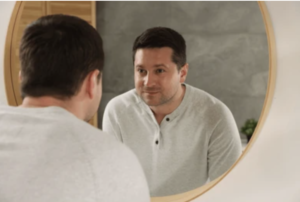
Self-consciousness is usually considered a negative experience. An awareness of oneself with the objective of observing the self to identify what other people would criticize in oneself. The implication is that the self-conscious person is trying to identify the souce of anticipated social discomfort and in some way protect against it. Furthermore, self-consciousness is usually considered an emotional burden resulting in awkwardness and some degree of social ineptitude. The usual advice given to the self-conscious individual is to relax and simply be oneself. Stop worrying about what other people think, and by implication stop tormenting yourself with a burdensome self-consciousness. The assumption here is that being oneself comfortably would naturally result in the absence of consciousness of self and easier functioning in the world.
I believe self-consciousness also has a positive application in life. A person can be self-conscious for the purpose of identifying what is unhealthy in one’s psychological functioning. We humans possess the ability to become aware of ourselves as though there is a self being observed and a self observing the self being observed. I can imagine a myriad of reasons where this kind of self-consciousness would come in handy. For example, let’s say you’ve unconsciously learned something unhealthy about people that inhibits you when you are in the presence of other people. Unmodified or not corrected, this type of self-consciousness could presummably make it difficult to interact with strangers for networking and/or friendship. You’d probably shy away from opportunities to socially engage and chances are your self-esteem would be less than what it should or could be.
The first step in an effective process of change would be to become conscious of the problem. That would involve seeing yourself in action. Becoming conscious of how you avoid interacting with others in ways that would be enriching and expansive. Self-consciousness would be the essential first step in the process of unlearning what you have now become aware of in your self. This type of therapeutic self-consciousness could then be transformed into a dedicated ongoing self-challenge whose purpose is to disrupt the unconscious operation of the unhealthy learning whenever it shows up. To complete the process of psychological change, once challenged and effectively stopped with positive consciousness, the next and final step would be to correct what was learned by learning something healthier to take its place.
Generally speaking, I believe self-consciousness is an inadequately acknowledged human capacity to help ourselves, derived from our innate ability to be conscious of ourselves. As a “tool” of consciousness, it is entirely possible to learn and practice the ability to unlearn and correct what we’ve learned when it is unhealthy. This brand of self-consciousness is fundamentally a psychological way of relating to ourselves. The intrapersonal relationship we have with ourselves is a relationship that can be made healthier and more intimate just like any interpersonal relationship. When the consciousness of oneself is practiced as a compassionate self-supervisory experience, its purpose is to guide the self away from harm and self-destructive activities. Taken to its ultimate benefit, positive self-consciousness is an ongoing effort to take better and better care of ourselves.
A positive self-consciousness is one of those “tools of consciousness” that can be learned and practiced by a psychotherapy patient, for example, who becomes dedicated to growing an ability to self-reflect, self-challenge, and self-correct as a life-long practice of self-discovery and self-development.
Comments welcome…
Dr. Thomas Jordan, clinical psychologist, psychoanalyst, psychological disability consultant, speaker, and author of the award-winning book, Learn to Love: Guide to Healing Your Disappointing Love Life. Presentations and telehealth Love Life Consultations available upon request. Contact: 212-875-0154 or drtomjordan@lovelifelearningcenter.com for inquiries. Visit my speaker page at lovelifelearningcenter.com/speaker